
The Big E
 Radiometric Dating
"Radiometric dating proves the earth is millions, even billions of years old."
We've heard it everywhere, from when we were in school to the modern science shows on TV, and everywhere in between. But are these findings actual facts (science), or are there assumptions involved?
An Overview of the Process
Before we can validate the findings for ourselves, we must firs look at the process. Though the process is quite complex, we will keep it at an overview level.
Radiometric dating, often used on rocks, looks at the radioactive decay as one element (parent) decays into another (daughter). Two examples are uranium as it decays into lead or potassium into argon. When studying a specimen, scientists look at the current decay rate, the amount of parent element remaining, and the amount of daughter element present. By comparing theses findings, scientists calculate when the rock (or other object) was formed.
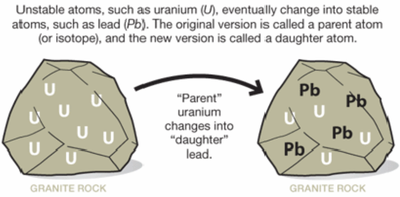
A great analogy is to visualize an hour glass. Imagine I show you an hour glass and ask you to evaluate how long it has been running. As you make your observations (science), you note the following:
- There are 25 grains of sand in the top portion (representing the parent element)
- There are 35 grains of sand in the bottom portion (representing the daughter element)
- Sand is dropping at 1 grain per minute (representing the decay rate)
Knowing that, how long has the hour glass been running?


Did you get the same answer everyone does? Easy, right? But is it actually correct?
Instead, I tell you that the hour glass has only been running for five minutes. Is that possible?
When you came to the conclusion of 35 minutes, how did you do that? You observed the current state of the hourglass, but did you have to make any assumptions? Yes.
Whether you realized it or not, you assumed that all the sand was in the top when the hourglass first started running as well as that the sand has been falling at the same rate the entire time.
Instead, when I created the hourglass, I placed 30 grains of sand in the top portion and another 30 grains in the bottom. Five minutes prior to your arrival, I stood the hourglass upright and the sand began to fall. Therefore, it only takes five minutes to reach the current state of the hourglass.
In the same way, many scientists assume (not science) the same things about the specimens they are attempting to date. They assume that there were no daughter elements present when the specimen was created. They also assume that the decay rate has been constant over the life of the element. Can you see how this is very inaccurate?
For a deeper look into the process, visit the following web sites:
Institute for Creation Research
Professing themselves to be wise, they became fools, Romans 1:22
 previous page